
 H5P Drag and Drop
The musculoskeletal system
Use the drag and drop names for the major muscles and bones of the human body to test your existing knowledge of the muscular system and the skeletal system!
H5P Drag and Drop
H5P Drag the Words
Lesson FGH
sadas
H5P Drag the Words  H5P Question Set
H5P Image Slider
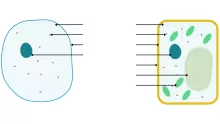
PLANT CELL AND ANIMAL CELL
Students are expected to understand that both plants and animals are made of eukaryotic cells that share many common organelles, but also have key structural differences that relate to how each organism lives. More specifically, by the end of the lesson students should be able to: Identify and label the major organelles of plant and animal cells (cell wall, cell membrane, nucleus, cytoplasm, chloroplast, vacuole, mitochondrion). Describe in simple terms what each of these organelles does for the cell (for example, mitochondria for energy, chloroplast for making food, cell wall for support). Differentiate plant and animal cells by indicating which organelles are present only in plant cells (cell wall, chloroplasts, large central vacuole), which are present in both, and how this affects cell shape. Explain how these organelle differences make plant cells better suited for standing upright and making their own food, and animal cells better suited for movement and flexible body forms. Summarize at least one clear similarity and one clear difference between plant and animal cells, using correct scientific vocabulary.
H5P Question Set
H5P Interactive Video
H5P Question Set
H5P Flashcards
H5P Accordion  H5P Question Set
H5P Tabs
H5P Tabs